|
|
|
Settler |
Settled for |
Events |
Empty for |
|
Banba |
40y |
Arrived with 150 maidens & 3 men (inc. Ladra) from unspecified origin. Died of disease. (Banba story attributed to Quire of Druim Snechta) |
200 years |
|
I. Cessaira |
6d, 40d |
Came from Egypt with 50 maidens & 3 men (her father Bith, Ladra the pilot, Fintan) Landed at Dun na mBarc (in Corkaguiney, northern Kerry) All (except Fintan) died before the Flood, Cessair from heartbreak at her father's death
|
300-312y, 1002y |
|
Capa, Luasad & Laigne |
0d |
Spanish fishermen & their wives; drowned at Tuad Inbir (Bann estuary) by the Flood |
|
|
II. Partholon |
300y, 550y |
Came from Sicily or Graecia Parva with his 4 sons, after killing his parents Lake-bursts occurred; he had plains cleared Originator of cattle husbandry, cooking, drinking, duelling, etc. Partholon cuckolded by his servant Topa, whom he then killed Killed by plague (except Tuan MacCairell) on Old Plain of Elta of Edar (Howth) or driven out by dog-headed apes |
30y |
|
III. Nemed |
400y, 630y, 720-730y |
Came from Greece with his 4 sons; many drowned capturing a tower of gold in the sea |
200y, 230y |
|
IV. FirBolgb |
30y, 36-37y |
Came from Greece, where they had been slaves Three groups arrive in same week: Gaileoin (warrior-chiefs), Fir Domnann (diggers) & Fir Bolg (carriers) Their five chiefs divided Ireland into the traditional 'fifths' First mention of a Brug in Lebor Gabála Érenn Last FirBolgb king (Eochu mac Erc) moved royal centre to Tara (Mound of 3 Men, Carn of One Man erected)c Fled to island strongholds after defeat by Tuatha De Danann at 1st Battle of Mag Tuired (see below) Descendants (='Sons of Umor') regained Irish territory (e.g. they built Dun Oenghus) during Ulster cycle | |
|
V. Tuatha De Danann |
196-197y |
Came from North of world, where they had become experts in magic, possibly via Greece and then Scotland Nuadu king (4-)7y before arrival Arrived in dark clouds without ships, or in ships which they burnt on alighting Brought 4 enchanted objects: Lia Fail, Lug's spear, Nuadu's sword, and Dagda's cauldron Beat Fir Bolg at 1st Battle of Mag Tuired (Moytura, Cong, Co. Galway) but with heavy losses, inc. Ernmas, Tuirill Biccreo, Fiachra, Ectach, Etargal, and Nuadu's arm Kingship to Bress (7y); then to healed Nuadu (20y), who fell defeating Fomoire at 2nd Battle of Mag Tuired (nr. Sligo), 27y after Tuathat De Danann arrived. Macha, Ogma, Bress, Bruidne, Casmael also fell. Lughnasa instigated at Tailltiu (Telltown, Co. Meath) in memory of Tailltiu, foster-mother of Lug, who died there Kingship to Lug (40y); then Dagda (80y) over whom was made Brug na Boinne (Newgrange). Brigid had some magic animals, who produced demonic voices (whistling, outcry & groaning) after plunder. Lug demands wergild of 7 enchanted items from Brian, Iuchar & Iucharba for killing his father Cian in theBrug. Kingship to Delbaeth (10y); Fiachna (10y) Kingship to MacCuill , MacCecht and MacGreine |
(29y) |
|
VI. Sons of Mil |
to historical times |
Milesians voyaged to Ireland to avenge Ith; The land was disguised as a hog's back; on landing, the lake-burst of Loch Luigdech Fought Tuatha De Danann (& poss. Fomoire) at Battle of Sliabh Mis, then Battle of Lifé Colloquy with Banba, Fotla & Eiriu regarding the name of the land In Teamair (Tara), MacCuill,MacCecht and MacGreine gain 3 days reprieve; Milesians sail, battling druidic storms, Eber Donn drowns MacCuill,MacCecht and MacGreine & wives killed by Milesians at Battle of Tailltiu (by Eber, Erimon & Amorgen, resp.) Eber Finn took kingship of the south (+5 chieftains), while Erimon took the north (+6 chieftains) A poet went with Eber, a harper with Erimon. Many raths and dúns constructed. Tuatha de Danann settle around Tailtiu. Alternative sequence: Landing, colloquy, departure & druidic winds, Battle of Sliabh Mis, Loch Luigdech burst, Battle of Tailtiu- |
|
|
Milesian kings (early ones only) |
After a year, Erimon fought and slew Eber, becoming sole king The Cruithne (Picts) came to Ireland but were banished to Scotland by Erimon; he gave them widows from the ship of Donn for wives, provided that Cruithne women could inherit & rule Lake-bursts, building of Raths, etc. continued in these times; also battles against Fomoire Kingship alternates (by battle) between the lineage of Erimon & Eber, up to Tigernmas (gt-gt-grandson of Erimon). Under Tigernmas were battles v. Fir Bolg; also smelting of gold, coloured garments (tartan), worship of Crom Cruach. Tigernmas died with 75% of the men of Ireland in a Samain ritual to CC. |
||
Footnotes to Table 1:
a / The Cessair story was originally a cosmogenic flood myth that existed independently of the Biblical Flood, but later the two floods came to be regarded as a single event. In the original Cessair myth, she and her people would have survived their flood, and Ladra/Adna would have united with all of the women and re-peopled the earth. The Cessair story has also become compounded with the Banba story and vice versa, so that the identities of Banba and Cessair are now interlinked. The fact that Cessair, rather than one of the men, is the key figure in this invasion reflects the primal myth of Ireland first being discovered by a woman.
b/ Macalister considered that the name Fir Bolg meant 'Men of Breeches', i.e. serving classes. He also considered them to have a close association with pigs. The Fir Bolg and the Fomoire are closely identified with one another, as follows. The Fir Bolg were dispersed into island strongholds after the Tuatha de Danann arrived, outposts typically associated with the Fomoire. Indeed, in Cath Maige Tuireadh the Fir Bolg returned from these outposts in alliance with the Fomoire to battle the Tuatha de Danann at Second Battle of Mag Tuired. Descendents of the Fir Bolg were later known as 'Sons of Umor', and the earliest Fomorians were also descended from one of this name. However, the Fir Bolg Umor seems to have been born later in time, since he appeared when the exiled Fir Bolg tried to regain territory in Ireland during the Ulster Cycle of Irish mythology. The sons of this Umor were: Oenghus (who built Dun Oenghus, and whose son Conall was slain by Cu Chulann), Cime-four heads (who was slain by Conall Cernach), Taman, Mod, Mil, Concraide, Cutra, Bera, Dalach, Bairnech, Adar the poet, Cing, Mend the poet, Uar, Aenach, Assal, and Irgus.
The relics of the Fir Bolg in Ireland in historical times (when the Lebor Gabála Érenn was being written) were: the Gabraide of the Suc in Connaught, the Ui Tarsaig, and the Gaileoin in Leinster.
c/ The various names of Tara through the ages are listed in Macalister's ¶444 (Vol V, p.83)
d/ Several different accounts exist for the origins of the Tuatha De Danann. A harmonized account, which reconciles the major variants into a single narrative, might read as follows:
After the defeat of the Nemedians at Conaing's Tower, the seed of Bethach s. Iarbonel the Soothsayer s. Nemed fled from Ireland into the north of the world (to wit, the northeast of Scandinavia) where they learned magic and wizardry. There were four cities where they acquired this knowledge, to wit Failias, Goirias, Findias, & Muirias. Thereafter they went to Greece for further training and to seek "the maiden", whom they captured. During their time there they were accounted poets of the Greeks, and they had a special power of sailing together on the seas without the need for ships. After their training in Greece was complete, they travelled to Dobar and Iardobar (poss. River Dour, Aberdeenshire) in north Scotland, where Nuada was their king for 4-7 years. Then they came in dark clouds to Ireland, and alighted on the mountain of Clonmaicne Rein (identified as being in southern Leitrim); or alternatively, they came to Ireland in ships, which they burnt on landing, and proceeded under cover of the dark clouds of steam and smoke to Sliabh an Iarinn (a mountain in Co. Leitrim, which still bears this name).
Figure 1. A genealogical tree for key persons named in the Lebor Gabála Érenn, from the Old Testament patriarch Lamech to the early Milesian kings.
The figure is provided as a file called Fig. 1 (LGE Genealogy).pdf, a bitmap saved in PDF format that can be opened using Adobe Acrobat reader. This is how the Figure is structured...
click on picture and it will go to the original pdf where it can be scaled up 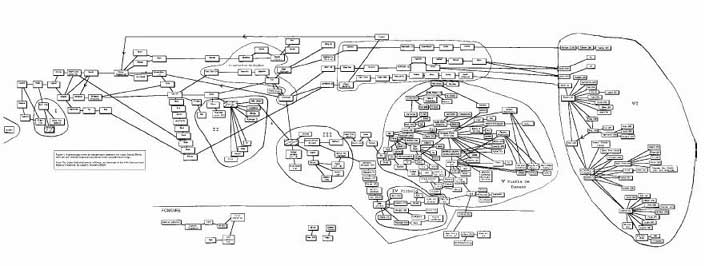
and the following is a close-up from the Tuatha De Danann part of the Figure...

|
Conventions & symbols in the Figure: Line linking boxes means left person begat right person -<- (reverse arrow) means reverse of the usual convention (i.e. rightmost begat leftmost) Multiple lines - if different redactions provide different lineages, then all versions are shown whenever practical (especially if this merely requires placement of additional links between persons already included in the Figure). Note that only R1 has been followed for persons in the LGE section entitled The Early History of the Gaedil. (Name) denotes an alternative name for a person (number) directs reader to a numerical footnote (see below) Curving lines enclose each of the different Invasions, and the Roman numeral (I-V) in each enclosure corresponds to the Invasion number in Table 1. Two other enclosures are also present; these group people with a common activity that is specified by the caption within the box. Lastly, a zig-zag line partitions the Fomoire into a strip along the bottom of the Figure. /// cross-hatching of a box shows that this is the person for whom the Invasion is named. If the Invasion is not named for a person, then the name of the Invasion is printed next to the Roman numeral for the Invasion. Female names are in CAPITALS = or II linking boxes indicates persons were husband and wife $ means unspecified number of generations (more than one) # means fosterage [ ] notes some significant attribute of the person |
|
Numerical footnotes to the Figure: 1. daughter of Pharaoh; married Erimon s. Mil after Mil's death |
___________________________________________________________________________
* Contact details: P.O. Box 184, North Ryde, Sydney, NSW 2113, Australia. Article completed in January, 2002.
© Copyright Lloyd D. Graham, all rights reserved. Maintained on Mary Jones’ website with the permission of the author.


