The Tara Skryne (Gabhra) Valley in
Early Irish Literature
by - Dr. Muireann Ní
Bhrolcháin
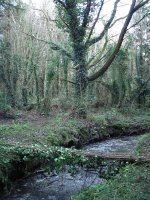 The area known as the Gowra (Gabhra) Valley lies
between the Hills of Tara and Skryne, the precise area
threatened by the proposed tolled M3 motorway. The valley
is criss-crossed by little brooks fed by the springs
around Tara and the Gabhra is one of these streams.
The area known as the Gowra (Gabhra) Valley lies
between the Hills of Tara and Skryne, the precise area
threatened by the proposed tolled M3 motorway. The valley
is criss-crossed by little brooks fed by the springs
around Tara and the Gabhra is one of these streams.
Conor Newman describes it thus:
"A small stream, known today as Gabhra, feeds into the
River Skane at Dowdstown Bridge to the north-west of the
Hill of Tara. The Gabhra owes its origin in part to two
notable springs on the eastern flank of the Hill of Tara,
which served as wells from antiquity into modern times.
The first of these, known locally as St. Patrick's Well
(possibly Liaig), is still in use today and can be found
to the east of Ráith na Ríg, protected by a
small masonry vault (Pl. 16). The second spring, possibly
Nemnach (by reputation the site of the first mill in
Ireland; Petrie 1839, 163), is located at the south end
of the field containing Ráith Lóegaire.
Both of these sources eventually feed into a small lake,
which is part of the formal garden of Tara Hall (now
demolished), and thence flow as a stream down a deep,
narrow gorge (which was landscaped into a cascading
watercourse during the last century) due east of Tara.
The stream issues from the gorge into the valley between
Tara and Skreen and turns northwards on its journey
towards the Skane at Dowdstown Bridge. In 1993, the
ornamental lake and watercourses beside Tara Hall were
extensively bulldozed and filled. Another pond (32:55;
Pl.2), drawn as a square on the first-edition OS map
sheet 32, lying further to the east of Tara Hall,
adjacent to a field boundary, was also being partially
filled with rubble at this time. Finally, the River
Hurley, a tributary of the River Nanny, drains an
extensive area of land south and west of
Skreen".²
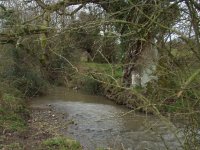 The word survives in the genitive case Gabhra
(Gabhra Valley), and the common usage in modern Irish is
gabhar (goat). However, the Dictionary of the Irish
Language has two relevant entries (i) gabor,
“goat” and it mentions, for example,
gaborchind “goat headed”. But there is a
second meaning to the word (ii) “horse, esp. white
one, mare,” which would indicate the meaning
“horse-headed”.
The word survives in the genitive case Gabhra
(Gabhra Valley), and the common usage in modern Irish is
gabhar (goat). However, the Dictionary of the Irish
Language has two relevant entries (i) gabor,
“goat” and it mentions, for example,
gaborchind “goat headed”. But there is a
second meaning to the word (ii) “horse, esp. white
one, mare,” which would indicate the meaning
“horse-headed”.
It is important that we listen to the stories that our
place names relate. They form part of our identity in the
same way as personal names and surnames. The gradual loss
of the Irish language alienates people from this age-old
identity and new place names, such as those used in some
modern housing estates, often bear no relationship to the
environment upon which they are imposed. The
unprecedented development taking place in Ireland over
recent years is altering the landscape irrevocably and
the disappearance of such features as a rath (enclosure)
or a muilleann (mill) can leave an area divorced from its
traditional place name containing that particular
element.
In his exposition of the essential status of landscape
among the Western Apache, Keith H. Basso dramatically
illuminates the quintessential position of places within
human culture. All Apache place names have stories that
baptised the landscape. He says:
"Thus performed and dramatized, Western Apache
place-making becomes a form of narrative art, a type of
historical theatre in which the “pastness” of
the past is summarily stripped away and long-elapsed
events are made to unfold as if before one's eyes. It is
history given largely in the active present tense
…"³
This could also describe many of our Old and Middle Irish
texts where the present tense is often used. Also these
Irish texts frequently end by highlighting the importance
of the places mentioned, emphasising how they are named
and the significance of the their survival into the
future.
The word gabor is incorporated in many others place
names. For example, it appears in a number of instances
in the text that tells of famous place names in Ireland,
the Metrical Dinnshenchas (The lore of famous places).
One of the first poems in the text, Temair V, is simply a
list of place names from all over the country, but it
includes both Loch nGabur (this is Loch da Gabar, Lagore)
and a Ráth Gabra – both included in a long
list of place names, most of them unidentified.
The poet finishes with the stanzas:
"The strongholds of Erin after these
I have left – I say without shame -
to someone else that shall be wiser,
who may traverse them unto Temair. Though there be over
imperial Banba
famous kings – high their mirth!
no kingly authority is binding on them
save from the king that possesses Temair. Maelsechlaind,
branch of bright fortune,
spreads peace about the ancient plain,
free from mortal pain beyond all generations, may he be
in the kingship of Temair".
Ráth Gabra remains unidentified in this list of
place names. Is it possible that this could refer to the
present day Rath Lugh (sic) which remains unidentified in
earlier sources?
A further occurrence of the word Gabra is in the poem
Brug na Bóinde ii in the place name Lecht Gabra.
This poem discusses Newgrange and various stories and
events connected with it. It says:
"Know ye the Grave of the Horse (Lecht Gabra) of the
king
Cinaed free from rigour of need?
he bore off victory from fleet ones of the bridle
at the will of the son of noble Írgalach".
The place name Gabra is also found in another poem Bend
Étair ii in a description of the journey that
Conaire, king of Tara, makes as he attempts to escape his
murderers.
"This was their road from Long Laga,
along far-stretching Tond Uairbeoil,
to Glenn da Gruad across Gabair
across Suan and across Sencharaid".
A prose section at the end of the Metrical Dinnshenchas
mentions Gabar in an explanation of the name Glaisse
Bulga and says:
"Glaisse Bulga, whence the name? Not hard to say. Glass,
daughter of Deg mac Dedad, reared Oscar, son of
Oisín, son of Finn. Cairpre son of Cormac ua Cuinn
slew Oscar in the battle of Gabair: and Glass came from
Luachair Dedad in the west to keen over her nursling at
his father's house. When she saw the house at a distance
with Oscar's family and foster-brothers round him, she
fell backwards and expired, so that all said: Glass lies
here prone like a sack, and it is her name that shall
cleave to this land till doomsday. Hence it was said:
Glass-ben, daughter of Derg son of Deda reared Oscar
– a notable honour: her heart broke, in sooth, on
the slope at Glaisse Bulga".
Here is the association between the death of Oscar,
Cairpre Lifechair, and the Battle of Gabair that is known
throughout Fiannaíocht literature as is shown
below. According to this saga cycle, the Fianna
“are brought to an end in the cataclysmic Battle of
Gabair for the forces of the new king of Ireland –
Cormac's son and successor Cairpre, who dies in the
struggle along with the great young Fenian hero Oscar and
most of the other fénnidi.” It was here that
the Fianna were finally decimated and it seems clear that
the location of this battle is the present-day Gabhra
Valley. The four saga cycles of early Irish literature,
Mythological, Ulster, Fiannaíocht and Cycle of the
Kings, intersect in the lore of the Gabhra Valley as
befits the most important landscape in the country. As
well as the destruction of the Fianna, their enemy in the
battle, Cairpre Lifechair, was killed in the same battle.
He was the son of Cormac mac Airt, the most famous of the
prehistoric, legendary kings of Tara.
Significantly, the battle is mentioned at the beginning
and at the end of the longest and most significant
Fiannaíocht text Agallam na Senórach. The
text has been recently translated again under the title
Tales of the Elders of Ireland and this is the
translation used below. The battle is mentioned along
with the two others, Cath Chomair and Cath Ollarba, and
at the end of the text the principal characters meet with
the sixth-century king, Diarmait mac Cearbhaill, at
Tara.
The text states at the beginning:
"After the battles of Commar, Gabair, and Ollarba, the
Fían was destroyed. The survivors scattered, in
small bands, across Ireland and, by the time our story
begins, only two of the nobles of this ancient
Fían were still alive: Oisín, the son of
Finn mac Cumaill 'the son of Cumall', and Caílte,
the son of Crundchú, son of Rónán".
(p 2)
A short while later the text describes their meeting with
Cáma, an old guardian of Fionn mac Cumhaill and
says:
"she spoke with them of the Fían … the
Battle of Gabair and other matters". (p 2)
Slightly later on, the text says:
"It was then that Patrick asked Caílte,
“What caused the destruction of all your
Fían?”
“The two battles that we fought at the end,”
said Caílte, “the battle of Gabair and the
Battle of Ollarba. We came in our three battalions to
give battle at the Estuary of Ollarba, and only six
hundred us came away. Until then Finn had always had
confidence in the Fían, whether in battle or
combat, but on this occasion he was struck by the loss of
the chiefs, lords, and champions, and the soldiers and
retainers that fell in these battles". (p 35)
At the very end of the saga, the two remaining noble
warriors end their journey in Tara and tell the incumbent
king, Diarmaid Mac Cearbhaill, of the demise of the
Fianna at the Battle of Gabair.
"Caílte and Oisín went then to Tara, and
told much knowledge and true lore in the presence of the
men of Ireland, and all that they said was preserved by
the ollaves of Ireland". (p 220)
The text continues:
"The King of Ireland then asked them: “Who killed
Cairbre Lifechair, son of Cormac, in the Battle of
Gabair?”
“Oscar, son of Oisín, killed him,”
said Caílte.
“A noble deed,” said Oisín.
“Who else did he kill?” asked the king.
“Orlám, the king of the Fothairt (Forth) in
the south,” said Oisín, “a beloved
warrior that was with me and with my father before
me.”
Oisín recited these lines:
“Orlám, the King of Fotharta's son, not a
gentle man.
Brother of Brónach, Cairbre Lifechair's
bane.”
“And Oscar then, who killed him?” asked the
king of Ireland. “A single cast of Cairbre
Lifechair, son of Cormac, killed him.”
“And Mac Lugach, who killed him in the
battle?” asked Diarmait, son of Cerball.
“Bresal, son of Éirge, the son of the king
of the Irish Vikings who had come here, and he was the
leader of the household of the king of
Ireland.”
That was the last evening of the Feast of Tara, and they
spent that evening in drinking and pleasure. The hosts
arose in the morning and the men of Ireland went off to
their own territories and provinces and places of origin.
The king of Ireland went off early in the morning to the
Stone of the Druids to the north-east of Tara with his
wife, Bé Binn, the daughter of the king of
Scotland, Alasc, son of Aengus.
“I desire,” he said to his wife, “to go
on the noble circuit of Ireland, and wish you to stay in
Tara to attend the elders, so that no reproach or rebuke
may come to me from the men of Ireland". (pp 221-2)
There are further references to the battle in a poem in
the Book of Leinster. The introduction says: “Ossin
sang – At the Battle of Gabair Oscur was killed and
Cairpre Lifechair.” The poem describes how Cairpre
and Oscar killed each other and continues:
"I was in the battle myself
On the south side of green Gabair
I killed twice fifty warriors
I killed them with my own hand". (baiss)
The battle is also mentioned in the Book of Leinster
genealogies where Cairpre Lifechair's death is recorded.
It says: “Cairpre Lifechair 18 years or 26 years
until he fell in the Battle of Gabair by Senioth mac Cirb
of the Fotharta.”
The Annals of Tigernach uses a slightly different and
much more pointed place name, stating that Cairpre
Lifechair fell by Seniach mac Fir Chirb do Fothartaib. It
says:
"Coirpre Lifeochair cecidit a Cath Gabhra Aithle la
Seniach mac Fir Chirb do Fothartaib". iiiim.cel.viiii.
(“Cairbre Lifechair fell in the Battle of Gabair
Aithle by Seniach son of Fer Cirb of the
Fothairt.”)
In the translation the editor says that Aithle should
read Aichle. Achall, of course, is the old name for
Skryne and this reference firmly links the two places
together. Achall belongs to the Ulster Cycle and she is a
daughter of Cairpre Nia Fer and of Feidlem
Noíchrothach, wife of Glan son of Carbad. Her
brother was Erc son of Cairpre Nia Fer and she died of
grief when he was killed. There is a poem on Achall in
the Metrical Dinnshenchas that explains how the place was
named and linking it to Tara:
"Achall over against Temair,/ the youths from Emain loved
her;/ she was mourned when she died,/ the white bride of
Glan, son of Carbad.
The daughter of Cairpri perished,/ the daughter of Fedelm
Noichruthach,/ from grief of Erc, (provinces were filled
with it),/ who was slain in vengeance from Cú
Chulainn.
Conall Cernach brought the head of Erc/ to Temair about
the hour of three;/ sad was the deed was done by him,/
the breaking of the cold heart of Achall".
The poet ends:
"Amlaib of Ath Cliath the hundred-strong,/ who gained the
kingship in Bend Etair;/ I bore off from him as price of
my song/ a horse of the horses of Achall. There came to
Temair of the kings/ Colum Cille free from sorrow;/ by
him a church is founded there/ on the hill where Achall
was buried".
In the later period, in the collection of Fenian lays,
Duanaire Finn (The Book of the Poems of Finn), the poem
beginning A Oisín cía in feart dona
(Oisín what sad mound is this?) is entitled by the
editor Gerard Murphy, 'The battle of Gabair'. Patrick
discusses the graves of the Fianna with Oisín. It
begins:
"Oisín, what sad mound is this/ that holds the
long grave?/ Tell us, blameless old man, what
grave-mound,/ it is which is thus greater than the rest.
(stanza 1) I have a tale for thee Patrick,/ for whom
bells are rung,/ concerning the guileless host of Tara/
and the beautiful Fiana of Ireland". (stanza 10)
The poem explains that Cairpre Lifechair, son of Cormac
mac Airt's son, asked Fionn for the hunting of Ireland
and that it was refused. The Fianna send messengers to
Cairpre in Tara giving notice of battle. Cairpre asks for
his allies to join him, including another Oscar, the son
of Garaidh.
"Osgar, son of glad Garaidh
advanced to Tara.
When he found not the king of Tara there
he went to Gabhair. (stanza 35) On the dread plain of
Gabhair,
chaste cleric,
we set a fence of shields and sharp ungentle point
around the lord of Ireland and Oisín. (stanza 51)
Many a shield was in fragments
on the hateful plain of Gabhair,
and many a body too lay wounded from the deeds
we did on one another". (stanza 54)
The poet tells of all the dead, explaining that the
Fianna are wiped out and that Cairpre Lifechair, king of
Tara dies. He has watched over their graves:
"Long have I been reckoning them up,
son of Calphrann, cleric,
watching their beautiful graves
on the many-fielded plain of Gabhair". (stanza 78)
The notes on the poem tell more:
"This poem on the Battle of Gabhair, of which the first
line is A Oisín, cía in feart dona, differs
from the poem on the same subject of which the first line
is Mór anocht mo chumha féin, two quatrains
from which are quoted by Keating in TBG2 5584sq., and
also from the other poem on the same subject of which the
first line is Innis dúinn, a Oisín. A
composite poem composed of these other two poems on the
Battle of Gabhair has been published by N. O'Kearney,
Oss.Soc. 1 p. 68. The first line of this composite poem
is Truagh liom Tulach na Féinne: the line Innis
<sin> dúinn, a Oisín, occurs on p.
72; the line As mór anocht mo chumha féin
on p. 110".
Duanaire Finn also contains a further poem, beginning A
Lía Thulcha Tuaithe shuas (O stone above on
Tualach Tuaithe) giving an account of the standing stones
erected by the Fianna over the graves of various famous
people:
"O stone of Gabhair of fierce horror,
planted by Caoilte son of Rónán
beneath whom lie two men of fierce courage, i. Mac
Lughach and Osgar – (stanza 88) O stone here on
Gabhair in the north
whom Fionn of the hard blades raised,
Cairbre Liffeachair, who was no weakling, lies beneath
thee, along with his good son.(stanza 90) O stone here at
the south on the steep hill,
raised by Oisín of the angry weapons,
the two sons of the king of Lochlainn beyond the sea
- beneath thee are those two men of might".
Kearney's book, as may be expected in the
nineteenth-century, treats the battle as factual history
and this is the case with most of the other authors he
quotes as well. He also identifies the site of the battle
as possibly being Garristown, Co. Dublin. The book
contains the composite poem along with a folklore-based
prose version, and another poem called 'War ode of Oscur
in the battle of Gabhra'.
The composite poem is a dialogue between Patrick and
Oisín, describing a slightly different scenario,
and the location of the battle is not clear from the
context. It says:
"Patrick: Narrate to us, O Oisín,
in honor of the spirits of the Fenians;
which of you were the strongest
in the battle of Gabhra of the strokes? Oisín: We
were but few in number,
opposed to the provinces of Ireland:
Fionn and his people
were on their way to Rome. We numbered thirty sons
of the tribe of Fionn of the Fenians;
who bore shield and sword,
in front of conflict and battle. When we marched from
Binn Eadair,
this was the number of our whole force;
ten hundred valiant Fenians,
in the bands of each man. The bands of the Fians of
Alba,
and the supreme King of Britain,
belonging to the order of the Fian of Alba,
joined us in that battle. The Fians of Lochlin were
powerful,
from the chief to the leader of nine men;
they mustered along with us,
to share in the struggle. There was Cairpre
Liffeachair,
and the great hosts of Erin;
opposed to our power,
in the Battle of Gabhra of the strokes. There was Oscur,
son of Garraidh,
and ten hundred active warriors;
augmenting the forces in that battle, in opposition to my
son".
It continues by enumerating in detail the heroes killed
in the battle particularly those who fell victim to Oscar
himself. Oisín then describes how Oscar died in
his arms and goes on to describe how they buried the
dead:
"Great was the calamity to us then,
that he died in our arms! From that day of the Battle of
Gabhra,
we did not speak boldly;
and we passed not either night or day
that we did not breathe deep heavy sighs. We buried Oscur
of the red weapons,
on the north side of the great Gabhra;
together with Oscur son of Garraidh of renown -
and Oscur, son of the king of Lochlann. … The
graves of the Oscurs, narrow dwellings of clay,
the graves of the sons of Garraidh and Oisín;
and the whole extent of the great Rath,
was the grave of the great Oscur of Baoisgne".
One of the physical features in the area of the Gabhra
Valley that they could have imagined as being the
“great Rath” and commemorative mound of the
dead Fianna is the present-day Rath Lugh.
O'Donovan also mentions the Gabhra:
"Gabhra: I then asked him (informant) where the following
places are situated according to the tradition amongst
the ancient people viz. … 4. Gabhra …
Gabhra: here a most tremendous [sic] battle was fought
between Fin Mac Cooil and his militia and Carbry the son
of Cormac Mac Airt, in which the former were cut off with
dreadful slaughter, and their power finally destroyed. In
this battle the most heroic Oscar, the son of Issin fell
by the sword of King Carbry. Tradition says that the
Gabhra (Goura) retains its name to this day and lies not
far to the north of Tara. It is a valley through which a
river, or large stream of the same name flows. If
O'Connor does not ascertain the situations and present
names of these places, I must visit them and it is more
than probable that he will not as the traditions are
forgotten in that side of the country.” (line 82)
“Gabhra and Gabhra Aichil near Tara, Haliday says
in a MS. of his, now in my possession, that Gabhra, the
site of the battle in which the Fingallians were finally
suppressed, is the present Garistown in the County of
Meath, but he is most unquestionably wrong".
Daithí Ó hÓgáin also
discusses the battle of Gabhra in his book on Fionn. He
says:
"The other [battle] was the battle of Gowra, a fatal
clash after the death of Cormac between the forces of
Cairbre Lifeachair and the Fianna. It is therefore a
final resolution in lore of the long-repressed rivalry
between the interests of Fionn and those of the Uí
Néill kingship; and it is significant that the
surviving scion of the Morna clan, Oscar mac Garaidh, is
put on the side of the Uí Néill in the
fighting … The day was won, but the Fianna
themselves were decimated. This was the battle which,
according to the Colloquy, Oisín and Caoilte
survived, thus giving the text the framework on which to
hang its anthology of lore and legend".
Thus, Tara and the Gabhra Valley, is the point where our
four story cycles unite in the juxtaposition of the
deaths, burials and inaugurations of kings and heroes.
Apart from the decimation of the Fianna, Tara, the Gabhra
and Achall (Skryne) is where Cormac mac Airt lived and
died, building Achall for himself in his old age, when
due to the loss of an eye, he could no longer live in
Tara, as blemished kings cannot reign. Lug, the most
revered of early Celtic Gods and known throughout
Continental Europe, is made king of the Tuatha Dé
Danann in the Banqueting Hall on top of the Hill of
Tara.
Finally and significantly, the hero of the Ulster Cycle
is connected with the Gabhra Valley as Cú
Chulainn's severed head is buried in Tara, although he is
killed in his native place - Mag Muirthemne in Co. Louth.
This is related in the twelfth-century Book of Leinster
version of the tale:
"Cú Chulainn's right hand was struck off in
vengeance. The hosts set out, and they took Cú
Chulainn's head and his right hand with them until they
reached Tara. That is the burial site of Cú
Chulainn's head and his right hand and the whole panel of
his gold shield".
It continues with a poem that says:
"His head is far from him
a firm fighter in Tara's hill.
His head is joined to Coirpre Nia Fer's trunk".
This is also mentioned in the text describing the place
names of Tara:
"The triple rampart of Nessa, Conchobar's mother at the
north-eastern end opposite the north-eastern end of Long
na mBan to the north-east. Ráith Chonhobair meic
Nessa beside the triple rampart to the north with its
door in the east opposite Méide Con Culainn.
The site of Scéith cona Thuil is opposite the
Méide to the north-east. Thus is this rath: level
on the ground with a small hill in its middle, it hollow
full of clay".
The Metrical Dindshenchas also mentions the burial of his
head:
"The Measure of the Head of grim Cú Chulainn
lies north-east from Rath Conchobair;
the dimension of his Shield under its Boss
is wonderful and huge".
It is patently obvious that the Gabhra Valley itself,
along with Tara and Achall at each end of the valley, was
a theatre of significant action in all four of the main
cycles of saga literature in early Ireland. This is also
a landscape of significance from a historical and most
particularly from a traditional point of view. The
proposed motorway would obliterate all its commemorative
importance, dividing Tara from Achall, Tara from Rath
Lugh and dissecting the Gabhra Valley – the site of
the last battle of the Fianna and the resting place of
Oscar son of Oisín and of Cairpre Lifechair king
of Tara. Effectively, the very core of early Irish
mythological literature would disappear forever under a
motorway's concrete and the concomitant development that
will undoubtedly follow.