|
POST OFFICES UK but still relevant to Transition Towns
It is no good anybody from the major political parties ringing their
hands
and saying how dreadful that Glastonbury is losing the Windmill Hill
Post
Office, or that Britain as a whole is losing so many, when their
parties
support the EU. These closures are a direct result of EU policy which
we
cannot opt out of, and that is known full well no matter what the
rhetoric
for public consumption may be.
Neither will any community
action help (though I think it is very sensible
to see what other provision
can be made) because the decisions are out of
our hands, as are many
others.
I append a potted history, courtesy of Newton Abbot UKIP. (And on
the
subject of stereotyping, UKIP are not 'right wing', 'Daily Mail
readers',
prototypical fascists or whatever comforting self-deception is
current, but
ordinary people waking up to the
lies.)
Best
Michael
PS You won't get very far with planners
these days either - their hands are
tied by endless EU
legislation.
"Up until the late 1990's Royal Mail had a monopoly of the
British postal
service. Because of that it was able to provide a universal
delivery and
collection service, common to all, regardless of where you lived
in Britain.
There were twice-daily deliveries and collections and, even in
the smallest
hamlets, a Post Office could be found. The whole thing worked
beautifully.
The profitable urban and city services off-set the less
profitable rural and
countryside operations. Like the village pub and the
bobby on the beat, the
network of Post Offices throughout the United Kingdom
became an integral
part of British life AND MADE A PROFIT! It was, quite
literally, the best
and most reliable postal service in the world.
The
European Union (EU), however, has an obsession with imposing
competition
regardless of whether or not a national monopoly, like the Royal
Mail, is
beneficial and works. In 1997, after publishing a press dossier
on
'competition rules to the postal sector', the EU Directive
97/67/EC
'Privatisation of Postal Services' introduced an EU-wide postal
service.
This was completely at odds with the unique British system. What to
do?
Quite simply, the Royal Mail had to go. This was achieved by gradually
and
secretly dismantling it.
The first step was the imposition of
Directive 97/67/EC which reduced the
Royal Mail's monopoly to mail weighing
less than 350 grammes. All other
areas were made available to privatisation.
This opened the door wide for
public sector companies, mainly the Dutch TNT
and German Deutsche Post, DHL,
to cherry-pick the profitable areas, leaving
the less profitable to the
Royal Mail.
More damage was inflicted with
a second EU Directive 2002/39/EC calling for
a 'step-by-step approach to
further market-opening'. In non EU-speak this
meant a further chunk of
Royal Mail business being made accessible to the
private companies. Within
less than a decade the once profitable Royal Mail
and its Post Office network
was fractured and losing money.
To add still further to its woes, British
politicians withdrew areas of
business from the Post Offices. Among other
changes, pensioners were nudged
into having pensions paid into bank accounts
and the purchase of TV licences
was taken away from Post
Offices.
Amazingly, the private postal companies can require Royal Mail
to handle
post on their behalf at a price to them of up to 9 pence a package
cheaper
than 2nd class charges. In reality this means the Royal Mail and the
British
taxpayer are subsidising the competition. Not surprisingly this
arrangement
has resulted in an 86% loss of profitability for the Royal Mail
in the first
half of 2006/07.
Westminster has been forced to seek EU
approval to subsidise Post Offices to
keep them open, albeit temporarily.
Approval has come at a heavy price. In a
letter (C(2007)5623final 28.11.07)
to David Miliband, Neelie Kroes, EU
Competition Commissioner, stipulated 'the
transformation programme (subsidy)
will involve reducing the Post Office
network by around 2,500'. The subsidy
is further restricted by EU 'state aid'
rules and cannot continue
indefinitely. It must end soon. What happens then?
No-one is saying.
In October 2007, the Minister for Employment Relations
and Postal Affairs,
Pat McFadden, when asked at a meeting at the Local
Government Offices in
Smith Square, London if he could guarantee that the
current programme of
closures would be the last, stated that he 'could not
say that'.
The EU has set 2009 as the year 'for the full accomplishment
of the internal
market for postal services' (art.14, EU Direct. 2002/39/EC).
This means
that, within less than twelve years, the destruction of the Royal
Mail will
be virtually complete and all achieved with the British public
blissfully
unaware of what has been really happening and why.
New
Labour, the Conservative and Liberal Democrat parties are all committed
to
Britain remaining in the European Union and subject to rule from
Brussels,
even if it means that, for yet another area of British life, the
Royal Mail
and its Post Offices, there is no future. That's how the EU and
British
politicians destroyed the Royal Mail."
|
|




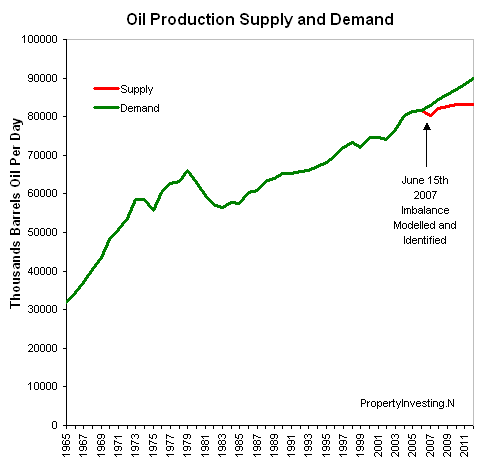 Obviously
this imbalance implies oil prices will shoot up – probably to $100/bbl
and then $125/bbl – which would then start to constrain demand - but we
believe it will require oil prices well over $100/bbl to have a
material impact on demand. Transport fuels (diesel) is a key driver -
and there is no reasonable alternative to the combustion engine at
present.
Obviously
this imbalance implies oil prices will shoot up – probably to $100/bbl
and then $125/bbl – which would then start to constrain demand - but we
believe it will require oil prices well over $100/bbl to have a
material impact on demand. Transport fuels (diesel) is a key driver -
and there is no reasonable alternative to the combustion engine at
present.  by Tara Tara Tara
 Luan Iúil 21, 2008 19:26


 Transition Towns in other places -