|
Gog and Magog
From Wikipedia, the free encyclopedia
is work Tafseer e Kabeer[36] and in his commentary on Surah Al-Kahaf (Urdu).[37] According to this interpretation, Gog and Magog were descendants of Noah
who populated eastern and western Europe long ago; the Ahmadi cite the
folkloric British interpretation of Gog and Magog as giants (see below)
as support for their view.[38]
[edit] In The Travels of Marco Polo
In The Travels dictated by Marco Polo, Gog and Magog are regions of Tenduk, a province belonging to Prester John, and governed by one George, fourth in descent from the original John. According to this account Gog (locally Ung) is inhabited by a tribe called the Gog, whilst Magog (or Mongul) is inhabited by Tatars.
[edit] As Napoleon in Russia
During the Napoleon Bonaparte's Invasion of Russia, some Chasidic rabbis identified this major war and upheaval as "The War of Gog and Magog", which would precede the coming of the Messiah [39].
[edit] Gog and Magog in Britain
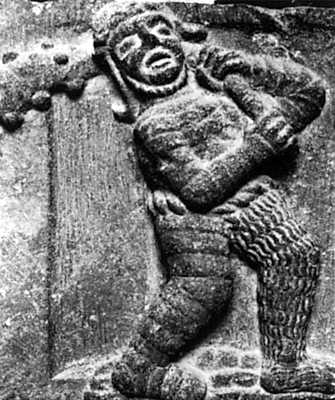
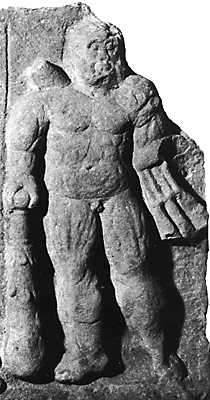
[edit] Giants
Given this somewhat frightening Biblical imagery, it is somewhat odd
that images of Gog and Magog depicted as giants are carried in a
traditional procession in the Lord Mayor's Show by the Lord Mayor of the City of London.
According to the tradition, the giants Gog and Magog are guardians of
the City of London, and images of them have been carried in the Lord
Mayor's Show since the days of King Henry V. The Lord Mayor's procession takes place each year on the second Saturday of November.
The Lord Mayor's account of Gog and Magog says that the Roman Emperor Diocletian
had thirty-three wicked daughters. He found thirty three husbands for
them to curb their wicked ways; they chafed at this, and under the
leadership of the eldest sister, Alba, they murdered them. For this
crime, they were set adrift at sea; they were washed ashore on a
windswept island, which after Alba was called Albion. Here they coupled with demons, and gave birth to a race of giants, among whose descendants were Gog and Magog.[40]
An even older British connection to Gog and Magog appears in Geoffrey of Monmouth's influential 12th century Historia Regum Britanniae, which states that Goemagot was a giant slain by the eponymous Cornish hero Corin or Corineus. The tale figures in the body of unlikely lore that has Britain settled by the Trojan soldier Brutus and other fleeing heroes from the Trojan War. Corineus is supposed to have slain the giant by throwing him into the sea near Plymouth. Wace (Roman de Brut), Layamon (Layamon's Brut) (who calls the giant Goemagog), and other chroniclers retell the story, which was picked up by later poets and romanciers. John Milton's History of Britain gives this version:
- The Island, not yet Britain, but Albion,
was in a manner desert and inhospitable, kept only by a remnant of
Giants, whose excessive Force and Tyrannie had consumed the rest. Them
Brutus destroies, and to his people divides the land, which, with some
reference to his own name, he thenceforth calls Britain. To Corineus,
Cornwall, as now we call it, fell by lot; the rather by him lik't, for
that the hugest Giants in Rocks and Caves were said to lurk still
there; which kind of Monsters to deal with was his old exercise.
- And heer, with leave bespok'n to recite a grand fable, though
dignify'd by our best Poets: While Brutus, on a certain Festival day,
solemnly kept on that shore where he first landed (Totnes),
was with the People in great jollity and mirth, a crew of these
savages, breaking in upon them, began on the sudden another sort of
Game than at such a meeting was expected. But at length by many hands
overcome, Goemagog, the hugest, in hight twelve cubits, is reserved
alive; that with him Corineus, who desired nothing more, might try his
strength, whom in a Wrestle the Giant catching aloft, with a terrible
hugg broke three of his Ribs: Nevertheless Corineus, enraged, heaving
him up by main force, and on his shoulders bearing him to the next high
rock, threw him hedlong all shatter'd into the sea, and left his name
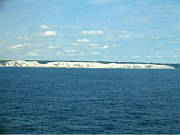
on the cliff, called ever since Langoemagog, which is to say, the Giant's Leap.
Michael Drayton's Polyolbion preserves the tale as well:
- Amongst the ragged Cleeves those monstrous giants sought:
- Who (of their dreadful kind) t'appal the Trojans brought
- Great Gogmagog, an oake that by the roots could teare;
- So mighty were (that time) the men who lived there:
- But, for the use of armes he did not understand
- (Except some rock or tree, that coming next to land,
- He raised out of the earth to execute his rage),
- He challenge makes for strength, and offereth there his gage,
- Which Corin taketh up, to answer by and by,
- Upon this sonne of earth his utmost power to try.
[edit] Gog Magog Hills
-
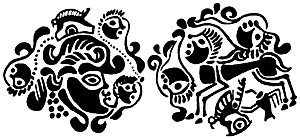
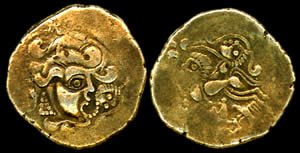
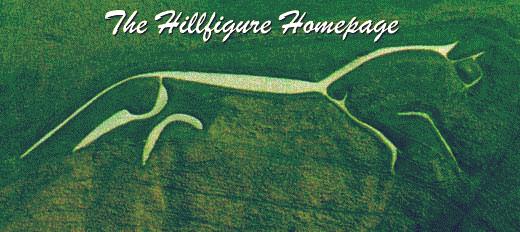
The Gog Magog Hills are about three miles south of Cambridge, said to be the metamorphosis of the giant after being rejected by the nymph Granta (i.e. the River Cam). The dowser T.C. Lethbridge
claimed to have discovered a group of three hidden chalk carvings in
the Gogmagog Hills. This alleged discovery is described at length in
his book Gogmagog: The Buried gods [4],
in which Lethbridge uses his discoveries to extrapolate a primal deity
named 'Gog' and his consort, 'Ma-Gog', which he believed represented
the Sun and Moon.
Although his discovery of the chalk figures in the Gogmagog Hills has
been dogged by controversy, there are similarities between the name and
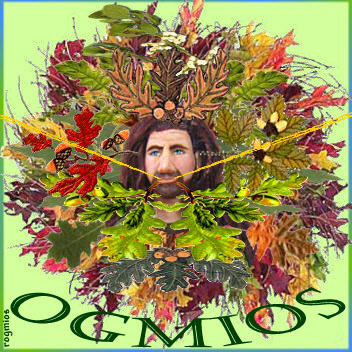
nature of the purported 'Gog' and the Irish deity Ogma, or the Gaulish Ogmios.
The Cambridge molly side, Gog Magog, take their name from these hills.
[edit] Gog and Magog in Ireland
Works of Irish mythology, including the Lebor Gabála Érenn (the Book of Invasions), expand on the Genesis account of Magog as the son of Japheth and make him the ancestor to the Irish.
His three sons were Baath, Jobhath, and Fathochta. Magog is regarded as
the father of the Irish race, and the progenitor of the Scythians, as well as of numerous other races across Europe and Central Asia.
Partholon, leader of the first group to colonize Ireland after the Deluge, was a descendant of Magog. The Milesians, or people of the 5th invasion of Ireland, were also descendants of Magog.
[edit] See also
http://en.wikipedia.org/wiki/Gog_and_Magog#Gog_and_Magog_in_Britain
|